
Liberal? or Not
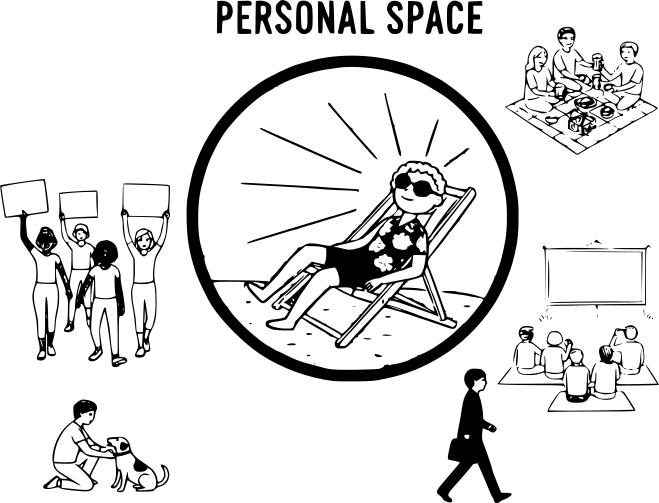
I think I am naturally liberal, though I define my liberalism less in terms of fluidness of ideology and more in terms of tolerance. All my life, I have rarely felt compelled to impose my will (political, religious, cultural, or otherwise) on anyone else. I may despise someone's way of life or values from a distance, but I almost never feel the urge to go out of my way and exert sustained effort—through taunting, policing, or coercion—to change how they live. It simply feels like too much work. I can debate and discuss viewpoints, but that is usually where my involvement ends.
This tolerance, however, is nothing special. I think it persists because what others do does not affect me personally. Why should I care if you like your coffee with salt, or prefer one genre of film over another? There are, of course, exceptions. I would not watch acts of violence against someone with casual indifference. And in my professional role as a doctor, I am expected to advise people on lifestyle change. Even then, this obligation operates at a rational, role-based level rather than as something I feel emotionally driven to enforce.
Experience has shown me that my liberalism thins out when my personal space or freedom is directly invaded. And I guess it's just common sense. You can do whatever you want; just don't point a knife at my belly, shout in my ears, or steal my belongings.
Because my tolerance varies according to how much I perceive something to affect my personal space and liberty, it is subjective. This subjectivity makes the philosophy feel unstable. What I consider remote or inconsequential to my personal space may be experienced by someone else as a profound grievance. In this framework, the boundaries of one's personal space largely determine how liberal one can afford to be. Shrink that space, and almost everything outside it becomes permissible and none of their concern. If it is still impermissible based on what they believe (but doesn't poke through their personal space), then they may feel compelled to try to change it, but at least it will be from a coolheaded place that seeks genuine discussion not heated confrontation.
Tolerant liberalism can therefore thrive chiefly (maybe only) under Individualism. A true liberal is Individualistic. With communalism, an individual's personal boundaries are often an amalgam of poorly conceptualized ideas from the group. Once a person blindly identifies with a group, they don't pause to think about what they truly feel about something, to examine hateful tendencies. The limits of their personal space expand outward, and intolerance toward opposing communities (or even dissenting members within their own) becomes more likely. Century-old wars and decade-old family conflicts are still being fought between people who have never known or long forgotten why the fight even started in the first place.
Does this mean people should avoid belonging to communities altogether? Should we all be lone wolves?
Not necessarily. Individualism is not a call to narcissism or selfish withdrawal. Rather, it is a demand for mindfulness, independence, and accountability: an insistence on not outsourcing one's thinking wholesale to the group.
It is a radical lifestyle that respects diversity without abandoning one's own principles. In this balance lies the true essence of liberalism.